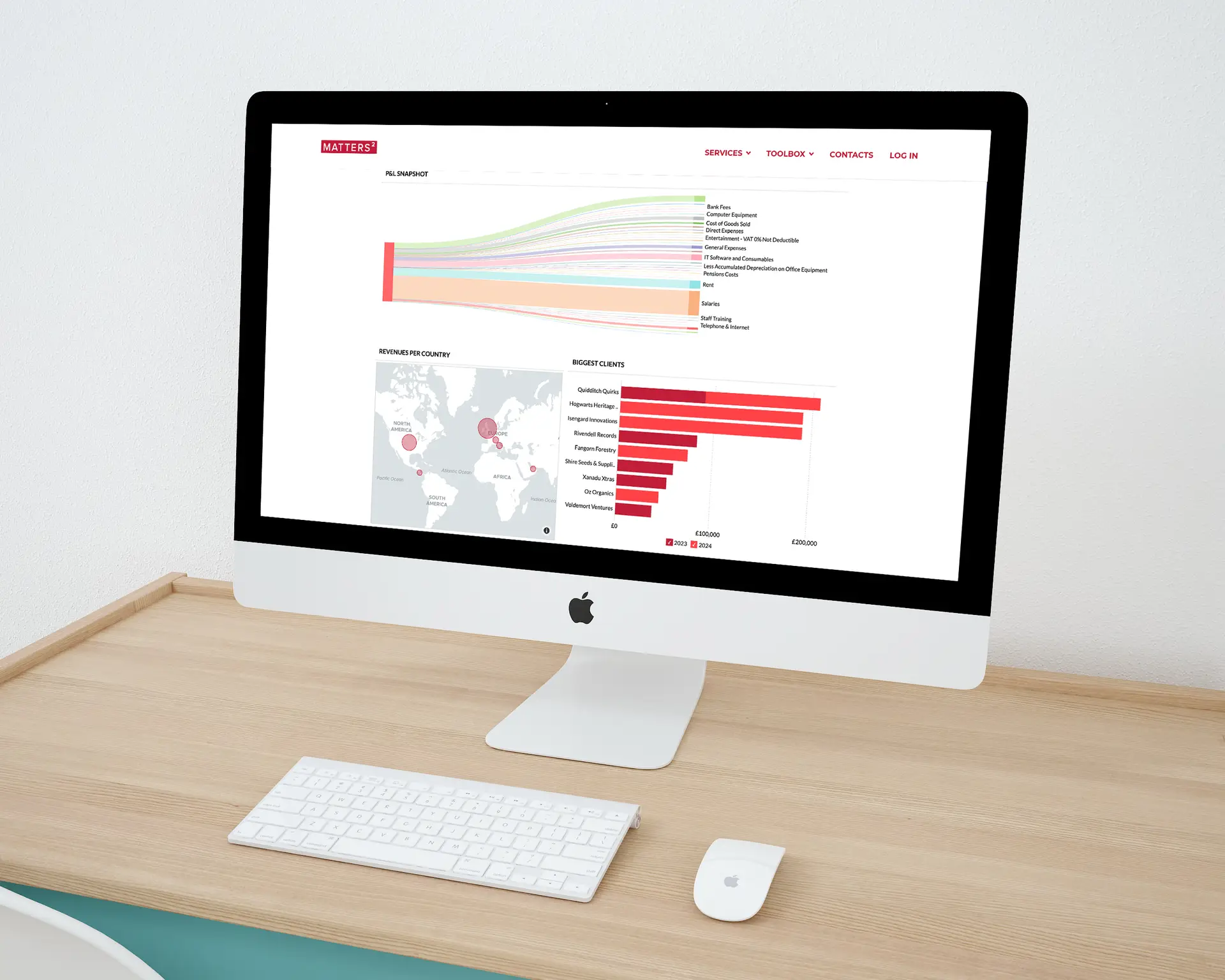
Real-Time Financial Clarity, One Project at a Time.
When you’re running multiple projects, stores, or events, knowing your overall profitability is important - but it’s not enough. What really matters is understanding how profitable each project is.
At Matters2, we believe entrepreneurs deserve real-time insights without drowning in complexity. Recently, a client’s board, a startup that designs and hosts impactful virtual and in-person events to strengthen supplier relationships and spark innovation, challenged us to go deeper: not just gross profit per event, but net profit per event. Here is how we cracked it and how you can too.
What Is a Project-Based P&L?
A project-based P&L (Profit and Loss) shows the revenue, direct costs, and overheads linked to a specific project.
It gives you a clear view of:
- How much each project is actually making you.
- Where your margins are strongest (or weakest).
- Where to focus your resources.
While many businesses stop at gross profit (revenue minus direct costs), net profit tells the full story by factoring in overheads like salaries, software, and general admin.
Where Most Businesses Struggle
Tracking revenue and direct costs for a project is usually straightforward with tools like Xero.
The challenge comes when you try to allocate overheads.
Most overheads are lumped together at the company level meaning you can't easily see which projects are truly profitable after everything is considered.
This is often where businesses lose money without even realizing it.
How We Solved It (A Real Example)
-
One of our clients organizes multiple large-scale events each year. They wanted to know net profit per event,not just at year-end, but in real time.
The good news? They were already using Monday.com to manage their event operations.
Rather than introducing new systems or manual spreadsheets, we:
- Tapped into Monday.com’s API.
- Pulled team time and resource allocation data per event.
- Used that data to fairly apportion overheads to each project.
This allowed us to calculate real-time net profitability per event - without adding extra admin work for the team.
How to Create a P&L Per Project - Step-by-Step
- Track Revenue and Direct CostsUse accounting software like Xero to record all project-specific income and expenses (venue rental, materials, contractors, etc.).
- Monitor Team Time and ResourcesUse a project management tool like Monday.com to track who’s working on what, and how much time they spend per project.
- Calculate Overhead ApportionmentDistribute overhead costs (like office rent, salaries, subscriptions) based on the actual effort or time spent on each project.
- Bring It All TogetherCombine the financials and time data to calculate net profit per project - and update it in real time as new data comes in.
Tools That Make It Easy
- Xero - for seamless tracking of revenue and direct costs.
- Monday.com - for live visibility into project operations and team effort.
- Simple dashboards (like PowerBI or Monday.com widgets) - to display real-time profit figures at a glance.
By connecting tools you already use, you avoid duplication and stay focused on running your business.
Why Project-Based Profitability Matters
Knowing your net profit per project lets you:
-
Double down on your most profitable activities.
-
Identify and cut underperforming projects early.
-
Price more accurately for future work.
-
Make decisions based on facts, not assumptions.
At Matters2, we believe entrepreneurs have the power to change the world - and better data helps them do it faster.
Conclusion
Creating a real-time P&L per project doesn't have to mean hiring a bigger finance team or building complex spreadsheets.
By leveraging tools like Xero and Monday.com - and connecting them smartly - you can track what really matters and stay one step ahead.
**Want help setting this up for your business?**At Matters2, we help entrepreneurs build financial systems that drive real growth.
Let's talk.