The industrial revolution is the best mental model for what is happening to professional services right now. Not because history repeats exactly — but because the structure of the disruption is identical.
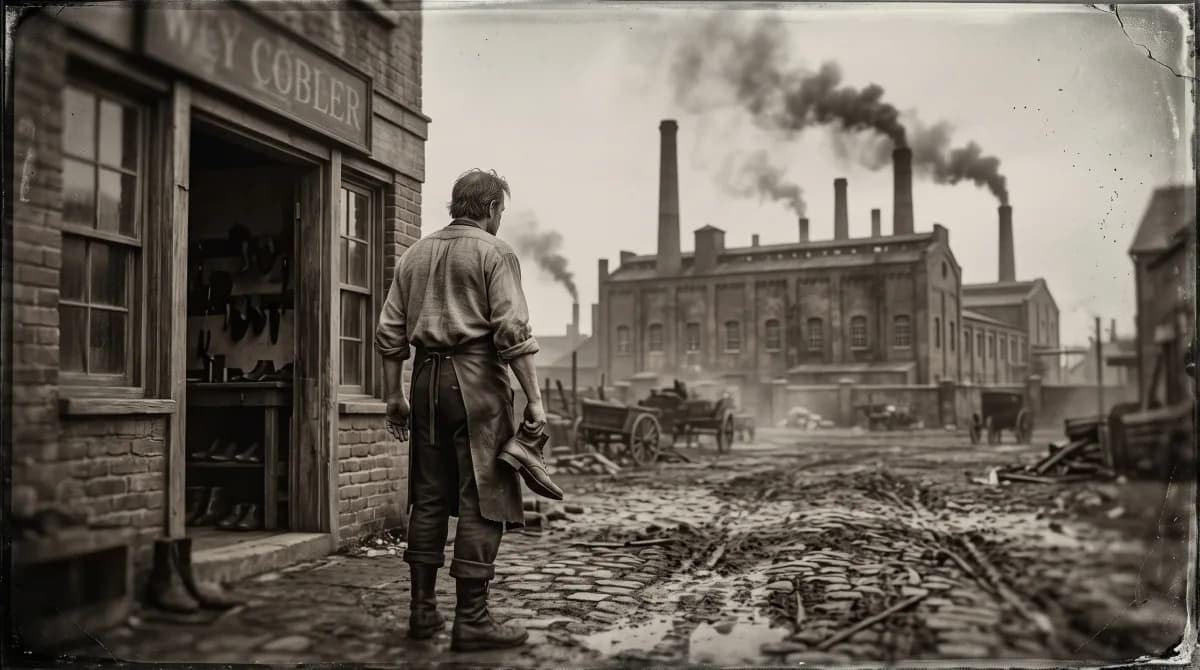
Industrialisation took skilled craft work, broke it into repeatable steps, and let machines do the steps. A skilled cordwainer spent hours on a single pair of shoes. A factory produced hundreds. The craft did not disappear — bespoke cobbling still exists and commands a premium. What disappeared was the market for mass-produced artisan work at artisan prices.
AI is doing the same thing to cognitive work: drafting, analysis, research, bookkeeping, coding, first-line advice.
The Structure of the Shift
The match is almost exact.
Automated muscle and manual dexterity → automated routine thinking and writing.
Cost collapse in goods → cost collapse in deliverables — reports, forecasts, contracts, code.
Early losers: artisans, guilds → early losers: junior analysts, generalist service firms.
Winners: factory owners, then distribution and brands → winners: owners of data, workflows, and client trust.
The price of standard output is already collapsing. Monthly management accounts. Basic financial forecasts. First-draft contracts. Market research summaries. These are not going away — they are becoming cheap, in the same way that machine-made furniture is cheap. The question is not whether this happens. It is how fast, and what it means for the firms providing those outputs today.
What Gets Scarce When Output Is Cheap
In 1800, the scarce thing was a well-made object. By 1850, factories had made well-made objects abundant. The scarce things became design, brand, and distribution — the things a machine could not copy.
The same substitution is underway in knowledge work. When a model can produce a competent first draft in seconds, the competent first draft stops being a scarce thing. What becomes scarce:
Judgment. The ability to look at three plausible options and know which one fits this company in this market at this moment. Models can enumerate options. They cannot carry the weight of being wrong.
Accountability. Someone who signs their name. Someone who can be called at 11pm when the numbers look wrong. Someone who has professional skin in the outcome.
Proprietary context. A generic model knows everything about finance in general. It knows nothing about your cap table, your supplier relationships, your board dynamics, or the deal that fell through six months ago. That context is irreproducible. Whoever holds it produces better output than any generic model can.
Trust. The kind that is built over years and does not transfer to a competitor because their subscription is cheaper.
The Three Positions
When a major production shift happens, there are three positions to take. This was true in 1850. It is true now.
The artisan
Defend the craft. Insist that what you do requires human skill and cannot be automated. This is correct about the output quality at the high end, and increasingly wrong about the price clients will pay for it. The artisan position survives as a genuine premium — hand-thrown ceramics, bespoke tailoring, the architect who builds one house a year. But it requires being genuinely at the top, genuinely differentiated, and genuinely priced at the premium. Most firms trying to hold the artisan line are not.
The lone machine operator
Adopt early. Use the tools. Offer services cheaper than before and more reliably than a firm running on pure human effort. This is the right move in the short term. It is also a temporary position. The machine operator's advantage is the gap between your tooling and your competitor's. As tooling commoditises — and it always does — that gap closes. The lone machine operator is better than the artisan in the transition period, but has no durable moat.
The factory designer
Rebuild service delivery from scratch as a workflow. AI does the steps. A human owns the outcome. The moat is not the ability to produce any individual output — it is the workflow design, the proprietary client context captured in that workflow, and the relationships that the named human carries.
The factory designer benefits from every improvement in the underlying machinery without being threatened by it. Better models mean better step-execution, which means the factory produces better outcomes, which means the factory's value goes up. The artisan is replaced by better machines. The machine operator is replaced by cheaper machines. The factory designer is empowered by better machines.
What This Means If You Are Buying These Services
The fractional CFO market, the accountancy market, the legal market, the strategy consulting market — all of them are going through the same transition at different speeds.
Standard output will price-compress. A fractional CFO who competes primarily on the quality of their monthly pack — the numbers, the commentary, the variance analysis — is in the artisan or machine-operator position. The output itself is no longer the moat.
The right question to ask your finance partner is not "can they do the analysis?" Any competent firm can. The questions that matter are: Do they carry accountability for the outcome? Do they hold enough context (in their heads and their systems) about your company that their judgment is better than what you could get from a generic service? Is there a named person who will be wrong with you when things go wrong, not just right when things are going well?
Your own operation is a factory too. The back office — planning, reporting, compliance, team coordination — is a production line. The question is whether it has been designed for the new production economics, or whether AI has been bolted onto the old model. Bolting a steam engine onto a craft workshop does not make it a factory. It makes it an expensive workshop.
How to Win
The factory builders who came out ahead of the industrial revolution followed a consistent playbook. The pattern holds.
Redesign the production line — do not just add tools. The early factories that failed bolted engines onto existing workshop layouts. The layout had to change too. Rebuild each service from the outcome backward: what needs a human judgment call, what needs proprietary context, and what is just a step that a machine can do reliably.
Sell outcomes, not hours. Fixed-price, productised services let you keep the efficiency gain instead of passing it to the client through lower rates. If you are still billing by the hour for tasks a model can do, you are either subsidising your client's adoption of AI or funding your own displacement.
Own proprietary context. Client data, history, and process knowledge make AI output better than anything a generic model can produce. That is the moat. Build it deliberately, protect it, and make sure it compounds with every engagement.
Move up to judgment and accountability. The person who signs off, carries liability, and advises on the decision is irreplaceable by design. Build toward that role.
Build trust and distribution now. Brand and relationships outlast any tool advantage. Everyone eventually gets access to the same models. The firms that are already trusted, already embedded in their clients' operations, already known by name in their market — those firms have a durable advantage that cannot be bought with a better subscription.
The Short Version
The industrial revolution took decades to settle and the transition was messy. Artisans adapted or specialised at the premium end. Machine operators worked until better machines arrived. The real winners designed production systems that improved as the machinery got better — and they owned the customer relationship that made it matter.
AI is not different. The structure is the same.
Do not be the artisan defending the craft. Do not be the lone machine operator. Be the one who designs the factory and owns the customer.
If you want to know where your back office sits in this transition — whether it has been redesigned for the new production economics or whether it is running on the old model with AI bolted on — a free systems check is a good place to start.